
Risorse per la registrazione wireless nei primati non umani
|
For many years, our laboratory has systematically employed wireless technologies to record neural activity in non-human primates, with the goal of combining behavioural ecology, data quality and animal welfare. The infrastructure has been designed to enable acquisitions under naturalistic conditions, both in the housing cage of individual subjects and in laboratory environments dedicated to neurobehavioural studies of the species-specific repertoire, without introducing experimental constraints. The animal facility is organized in communicating-cage systems, in compliance with Directive 2010/63/EU and Legislative Decree 26/2014, with animals housed in pairs or small groups in spaces above the legal minimum requirements. Large windows provide natural lighting and physiological day/night cycles, while environmental control systems and veterinary monitoring ensure stable welfare conditions that are continuously supervised.
Housing and laboratory cages are equipped with enrichment elements: physical-structural (climbing elements, ropes, hanging toys), sensory (visual and auditory stimuli), food-based (substrates and devices for scattering seeds and small food items), cognitive-occupational (puzzles and problem-solving tasks), and social (pair or small-group housing when appropriate). This architecture allows recordings during spontaneous activity and structured tasks, while maintaining continuity with the animals’ environment and daily routines. Preparation for sessions occurs exclusively through positive reinforcement and voluntary cooperation. Animals progressively learn to approach, enter and remain in the chair or in the plexiglass carrier for the brief time needed to connect the recording system, without resorting to head-fixation devices or other permanent restraint systems. When minimal stabilization is required to attach the wireless recording system, we use external and momentary supports. |
|
For fully free wireless recordings, we use a dedicated experimental cage1. This is a large structure with a strong vertical development, made of steel and plexiglass, equipped with wooden walkways and platforms, climbing grips, elevated perches and areas designed for object manipulation. This configuration allows macaques to walk, climb, jump, explore and interact with one another or with objects, expressing a wide repertoire of spontaneous actions while neural activity is recorded in a fully wireless mode. Around the cage, a multi-camera system is installed to reconstruct movement kinematics with high precision and align them accurately to the neural signal. In this context, accurate neurosurgical planning becomes essential: thanks to a neuronavigation system with subject-specific models (through the use of MRI and CT images), we are able to define optimal trajectories and perform targeted, repeatable implants. 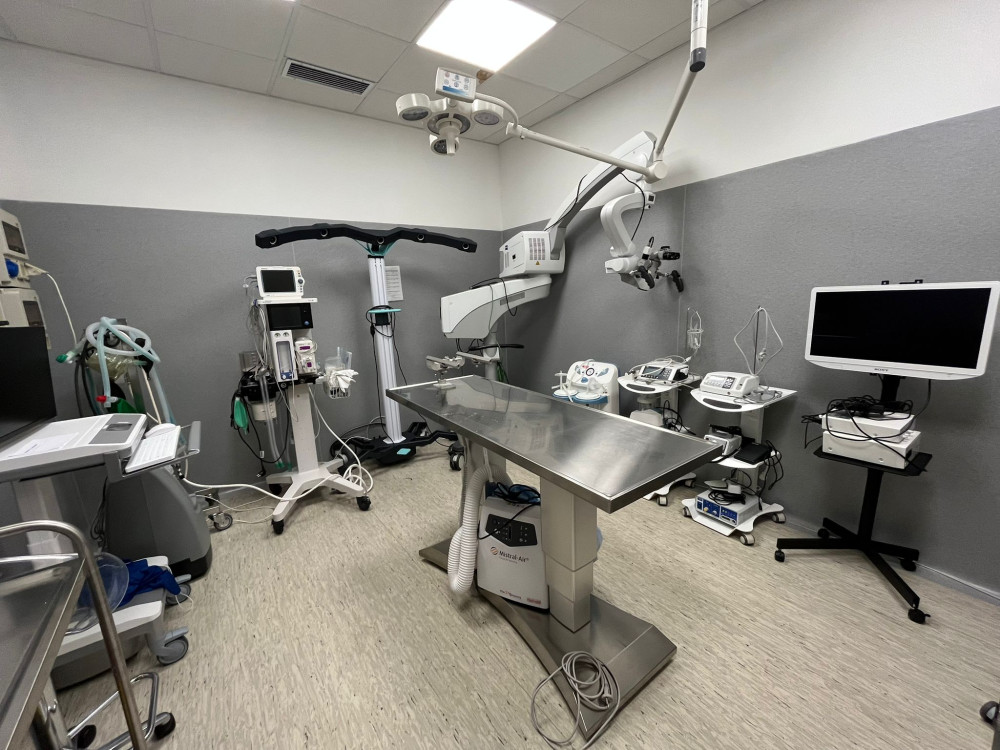
Surgery room
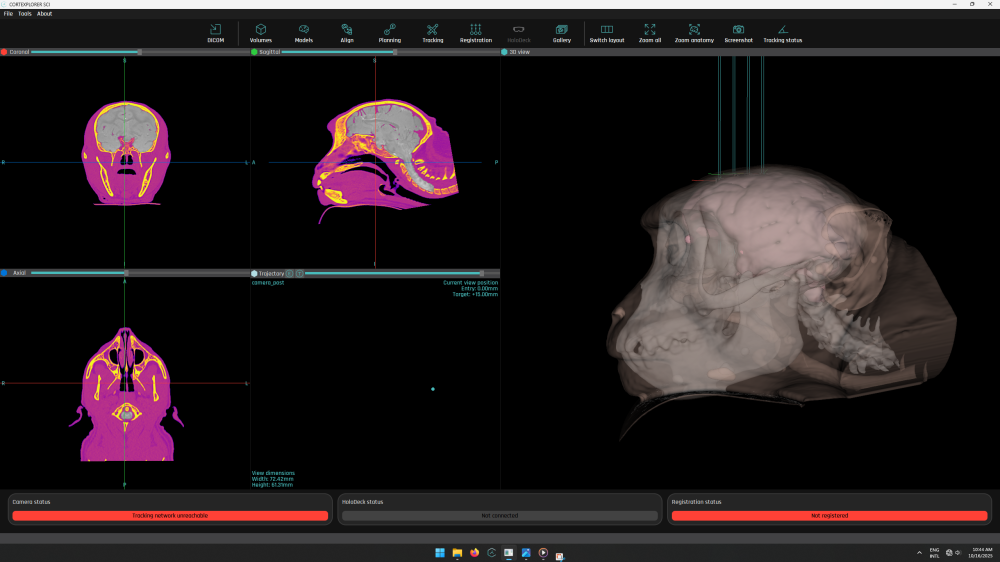
Cortexplore
|
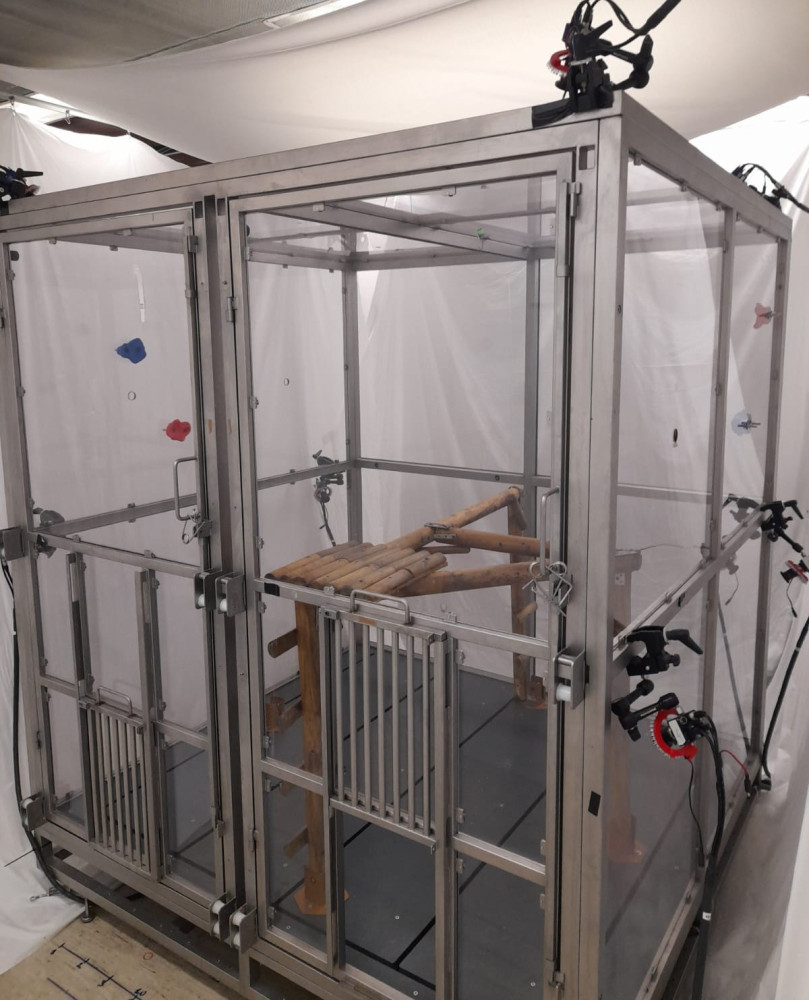 |
Wireless recordings combine multichannel electrodes with extensive non-invasive behavioural instrumentation. The neural signal is synchronized with multi-camera/IR video, allowing precise reconstruction of movement kinematics and neural dynamics during natural actions such as reach-to-grasp, exploration, locomotion and social interactions.
Attention to signal quality, lighting stability and tracking-system calibration makes the datasets rich, comparable and reproducible over time.