
CIRCEM
Local circuitries and neuronal classes for emotional and social affordances processing in the freely moving monkey
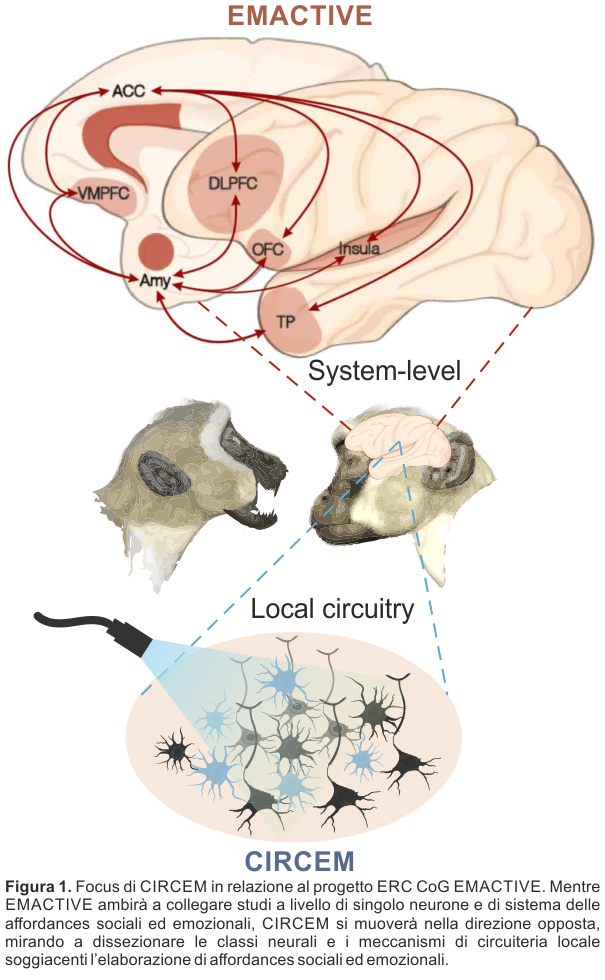 |
Extended networks of anatomically connected sensorimotor brain areas encode information from the physical objects that populate the external world and generate representations of potential actions (“affordances”) for interacting with them. Actions and emotions observed in others can constitute “social objects” capable of eliciting a variety of social and emotional affordances. The ERC project “EMACTIVE” will investigate social and emotional affordances from the single-neuron to the systems level, whereas CIRCEM will move in the opposite direction, exploring the local and cellular mechanisms within specific brain areas that underlie the encoding of one’s own and others’ social and emotional behaviours. In a first phase (WP1), CIRCEM will combine innovative electrophysiological approaches to the functional classification of single neurons, based on the physical properties of their action potentials—recently validated by the PI’s research group in premotor and parietal cortices—with optogenetic techniques that to date have only been used in a pioneering and sporadic manner in primates. The dual objective of this WP will be (1) the development and validation of the optogenetic approach in two dedicated non-human primates, and (2) the study of local mechanisms underlying the encoding of social affordances, providing direct evidence for the recently formulated hypothesis of the existence of inhibitory interneurons with “mirror” properties in premotor cortex. In the second part of the project (WP2), the technologies and optogenetic techniques implemented in WP1 will be applied to the study of local circuits and neuronal classes underlying social and emotional affordances in the amygdala and anterior cingulate cortex, key regions in EMACTIVE. The study of local circuits and neuronal classes underlying brain functions is particularly advanced in neuroscientific research on rodents, especially mice, thanks to the numerous experimental possibilities offered by these models. However, these studies are intrinsically limited by the behavioural repertoire of these species and do not allow for an immediate translation of the results to humans. CIRCEM will help open innovative lines of research of inestimable translational value towards understanding the cellular mechanisms underlying complex social behaviours and functions that are uniquely present in primates and are altered in a variety of still poorly understood human neuropsychiatric disorders, such as anxiety disorders and autism spectrum disorders, for which no definitive therapeutic approaches are currently available. |